







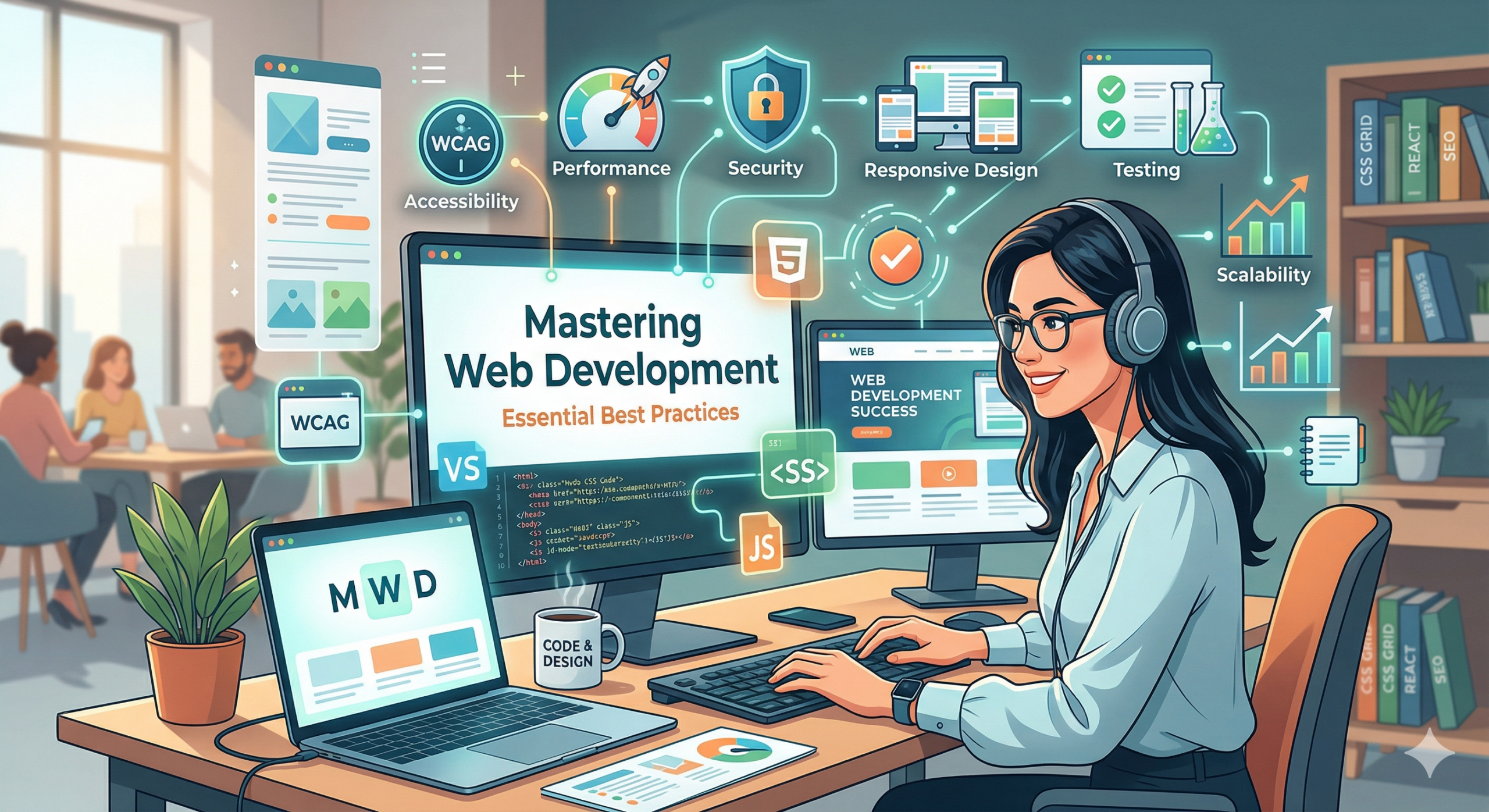
The digital landscape in Hong Kong is shifting at an incredible pace. As a result, to remain relevant, professionals must prioritise continuous learning and adapt to modern technical standards. In particular, mastering web development best practices is the primary foundation for creating robust, user-friendly online platforms that serve diverse needs.
Moreover, building dynamic and interactive experiences requires a deep understanding of current industry trends. By consistently applying these web development best practices, you ensure your projects remain competitive within a crowded marketplace. Ultimately, embracing these core concepts allows teams to optimise performance and deliver high-quality digital solutions that truly resonate with local users.
Essential Guidelines to Web Development
- Prioritise ongoing education to keep pace with rapid technological shifts.
- Focus on building resilient and user-centric digital architectures.
- Utilise modern coding standards to enhance site performance and security.
- Adopt agile methodologies to streamline the creation of interactive interfaces.
- Maintain a competitive edge by regularly auditing your technical workflows.
Table of Contents
Foundational Coding Standards and Clean Architecture in Web Development
Building a robust digital product starts with the bedrock of clean, professional code. From the outset, by adhering to established coding standards, developers create systems that remain flexible and easy to update as business requirements evolve. In this way, this disciplined approach is a hallmark of modern web development best practices, ensuring that technical debt remains low throughout the project lifecycle.
Adopting Consistent Naming Conventions
Clear communication is vital when working within a development team. For instance, using consistent naming conventions for variables, functions, and classes allows team members to understand the codebase without needing constant clarification. Consequently, consistency transforms complex logic into readable documentation that speaks for itself.
Furthermore, when every developer follows the same naming patterns, the risk of introducing bugs during updates drops significantly. In turn, this simple habit saves countless hours of debugging and improves the overall quality of the software. Therefore, it is a small investment that yields massive returns in long-term project clarity.
Modularising Code for Maintainability
Breaking large, monolithic blocks of code into smaller, reusable modules is essential for sustainable growth. By doing so, modular architecture allows developers to isolate specific features, making it easier to test and deploy individual components. As a result, this strategy ensures that your application remains highly maintainable even as it grows in complexity.
Additionally, by keeping functions focused on a single task, you create a system that is resilient to change. For example, if a specific feature requires an update, you can modify the relevant module without risking the stability of the entire platform. Therefore, this approach is fundamental to building scalable applications that stand the test of time.
Version Control Best Practices with Git
Git serves as the industry standard for tracking changes to a codebase over time. Not only does it provide structure, but it also offers a necessary safety net, allowing teams to experiment with new features while maintaining a stable version of the application. In essence, version control is not just about saving progress; it is about managing the history of your project with precision.
Moreover, effective use of branching strategies ensures that new code is thoroughly reviewed before it merges into the main production environment. Consequently, this workflow prevents accidental regressions and fosters a culture of accountability. By mastering these tools, developers can collaborate with confidence, knowing that every modification is documented and reversible.
Prioritising User Experience Guidelines in Web Design
Modern web development best practices place the visitor at the very heart of the design process. Therefore, when you focus on the needs of your audience, you create digital environments that feel natural and welcoming. In turn, adopting these user experience guidelines ensures that every interaction serves a clear purpose.
Designing Intuitive Navigation Structures
A website is only as effective as its ability to guide users toward their goals. To achieve this, you should implement clear, logical menus that allow visitors to find information without frustration. In addition, simple, predictable layouts are essential website design tips that keep bounce rates low.
“Design is not just what it looks like and feels like. Design is how it works.” ––– Steve Jobs
Accessibility Standards for Inclusive Web Design
True inclusivity means building a web that works for everyone, regardless of their physical or cognitive abilities. Accordingly, adhering to international accessibility standards ensures that your content remains readable for users relying on screen readers or keyboard navigation. By prioritising these web development best practices, you expand your reach to a wider audience in Hong Kong and beyond.
For example, always provide descriptive alt text for images and ensure sufficient colour contrast across your pages. As a result, these small adjustments make a significant difference in how users perceive your brand. Ultimately, inclusive design is not just a legal requirement; it is a hallmark of professional quality.
Optimising Page Load Speeds for User Retention
Technical performance is a critical component of website design tips that directly influences user retention. In fact, visitors often abandon sites that take more than a few seconds to load, leading to lost opportunities. Therefore, you must prioritise efficient code and compressed assets to maintain a snappy, responsive interface.
Additionally, fast loading times signal reliability to search engines, which can improve your overall visibility. By balancing aesthetic appeal with high-performance technical standards, you create a seamless experience that keeps users coming back. Ultimately, every millisecond saved contributes to a more satisfying journey for your visitors.
Implementing Mobile Responsiveness Techniques in Web Creation
A mobile-first strategy is the cornerstone of effective modern web design. Specifically, by prioritising the smallest viewports, such as a 320px screen, developers ensure that core content remains accessible to every user. Consequently, adopting these mobile responsiveness techniques allows your site to scale gracefully as screen sizes increase.
Fluid Grid Systems and Flexible Layouts
Moving away from fixed-width containers is essential for modern layouts. Instead, using relative units like percentages or viewport units ensures that elements adjust naturally to the user’s device. In this way, these website design tips focus on creating a fluid structure that prevents horizontal scrolling.
Furthermore, CSS Grid and Flexbox are powerful tools for managing complex layouts without relying on rigid pixel values. By defining flexible containers, you allow your content to reflow dynamically. As a result, this approach maintains visual harmony regardless of whether the user is on a smartphone or a desktop monitor.
Optimising Media Assets for Diverse Screen Sizes
Large images can significantly hinder performance on mobile networks. For this reason, it is vital to serve appropriately sized assets based on the user’s device capabilities. For example, using the srcset attribute allows browsers to select the most efficient image file for the current display.
Moreover, compressing media files without sacrificing quality is a critical performance factor. In particular, modern formats like WebP offer superior compression compared to traditional JPEGs. By automating this process, you ensure that your site remains fast and visually appealing across all platforms.
Testing Across Multiple Devices and Browsers
Even with a perfect design, technical issues can arise in different environments. Therefore, rigorous testing is one of the most important web development best practices to adopt. To ensure reliability, you must verify that your layout remains intact across various browsers and operating systems.
However, do not rely solely on browser developer tools for your quality assurance. Instead, testing on physical devices provides a true representation of touch interactions and performance constraints. Ultimately, this meticulous approach helps identify layout bugs that might otherwise go unnoticed.
Core Web Development Best Practices for SEO
Modern web development best practices must prioritise search engine visibility from the very first line of code. In other words, by aligning your technical architecture with search engine requirements, you create a robust foundation for sustainable growth. As a result, your digital presence becomes not only functional but also highly discoverable.
Semantic HTML and Proper Heading Hierarchy
Semantic HTML provides a machine-readable blueprint that helps search engines interpret your content accurately. For instance, by using specific tags such as <header>, <article>, and <nav>, you define the purpose of each page element clearly. Consequently, this structure allows crawlers to index your site with greater precision.
At the same time, maintaining a logical heading hierarchy is equally vital for accessibility and ranking. By organising content properly, you help search engines understand the thematic importance of your content. Therefore, a well-organised document structure is a cornerstone of effective SEO strategies.
Optimising Meta Data and Schema Markup
Meta data acts as the primary interface between your website and search engine results pages. In practice, crafting unique, descriptive titles and meta descriptions encourages higher click-through rates. As a result, these small details often determine whether a user chooses your link over a competitor.
“Good design is as little design as possible, but great technical structure is the invisible hand that guides users to your content.”
Furthermore, implementing schema markup provides search engines with structured data about your business, products, or services. Consequently, this additional context can lead to rich snippets, which significantly increase your visibility. Thus, leveraging these tools is a key component of modern SEO strategies.
Improving Core Web Vitals for Search Rankings
Core Web Vitals measure the real-world experience of your users. Specifically, they focus on loading performance and visual stability. Because of this, search engines now use these metrics as a direct ranking factor. Prioritising these performance indicators is essential for maintaining a competitive edge.
- Largest Contentful Paint (LCP): Focus on loading speed for the main content.
- Interaction to Next Paint (INP): Ensure your site remains responsive to user clicks.
- Cumulative Layout Shift (CLS): Prevent unexpected movement of elements during page load.
Therefore, by adhering to these web development best practices, you ensure that your site remains fast and reliable. In the long run, consistent performance monitoring will help you secure sustained traffic growth and user retention.
Securing Your Digital Infrastructure in Web Building
Developers must treat security as a continuous discipline rather than a final checklist item. Instead, integrating web security measures into every stage of the development lifecycle is essential. By doing so, you protect your users and ensure the long-term integrity of your digital assets.
Implementing HTTPS and SSL Certificates
Encryption is the first line of defence for any modern website. In particular, implementing HTTPS via SSL certificates ensures that all data remains private and secure. Therefore, this is not merely a recommendation but a mandatory requirement.
Defending Against Cross-Site Scripting (XSS)
Cross-Site Scripting remains a prevalent threat. To address this, developers must enforce strict input validation and output sanitisation. In short, never trust user-provided data.
Regular Security Audits and Dependency Management
A resilient infrastructure requires constant vigilance. For this reason, you should frequently review your codebase and third-party libraries. By maintaining updates, you ensure your system stays protected against evolving threats.
Security Strategy | Primary Benefit | Implementation Frequency |
SSL/TLS Encryption | Data Privacy | Continuous |
Input Sanitisation | XSS Prevention | Per Request |
Dependency Audits | Vulnerability Patching | Monthly |
Selecting and Managing Content Management Systems for Web Development
Your choice of CMS will dictate the long-term success and flexibility of your web project. Therefore, making informed content management systems (cms) recommendations is a strategic decision that influences how your team manages digital assets. By aligning your platform choice with specific technical goals, you ensure a smoother and more efficient development lifecycle.
Evaluating WordPress for Scalability
To begin with, WordPress remains a dominant force in the industry due to its vast ecosystem of plugins and themes. In fact, many organisations find that it offers exceptional scalability when configured with high-performance hosting and proper database optimisation. As a result, it is a reliable choice for businesses that need to grow their content footprint without rebuilding their entire infrastructure.
Leveraging Headless CMS Architectures
On the other hand, modern web development best practices increasingly include the adoption of headless CMS architectures. By decoupling the backend content repository from the frontend presentation layer, developers gain unprecedented flexibility. Consequently, this approach enables a seamless multi-channel experience across mobile apps, websites, and IoT devices.
“The future of content delivery lies in the ability to serve data anywhere, regardless of the device or interface, which is exactly what a headless approach provides.”
Maintaining Security in CMS Environments
At the same time, security is not a one-time setup but an ongoing commitment to web development best practices. For this reason, you must implement regular updates, enforce strong authentication protocols, and conduct frequent vulnerability scans. In doing so, you protect your digital infrastructure against constantly evolving cyber threats.
CMS Type | Primary Benefit | Best Use Case |
Traditional CMS | Ease of Use | Blogs and Small Business |
Headless CMS | Flexibility | Complex Web Applications |
Custom Framework | Total Control | High-Security Enterprise |
Ultimately, following professional content management systems (cms) recommendations helps you avoid common pitfalls. Whether you choose a traditional platform or a modern headless solution, prioritising security and scalability will safeguard your investment for years to come.
Mastering Web Development Best Practices
Mastering the craft of building for the web is a continuous journey. Above all, it demands a firm commitment to quality, security, and performance.
By consistently applying these web development best practices, you create robust applications that serve your audience effectively. In turn, these methods ensure your digital products remain resilient in a competitive market.
Ultimately, your success depends on how well you integrate user experience guidelines into every phase. At the same time, staying informed about modern SEO strategies ensures your content reaches the right audience.
Therefore, apply these principles to your current workflow to see measurable improvements—and continue evolving as the digital landscape advances.
FAQ
Why are coding standards considered a cornerstone of web development best practices?
Adopting rigorous coding standards ensures that applications remain scalable and maintainable over the long term. By modularising code and using consistent naming conventions, development teams can collaborate more effectively. Furthermore, utilising version control systems like Git provides a transparent history of modifications, which is essential for managing complex project lifecycles and facilitating seamless updates.
How do user experience guidelines influence the success of a modern website?
Following established user experience guidelines is critical for creating an engaging and inclusive environment. This involves designing intuitive navigation structures and adhering to accessibility standards to support users with disabilities. Incorporating these into your website design tips ensures that performance metrics, such as page load speeds, are optimised to improve both visitor retention and overall satisfaction.
Which mobile responsiveness techniques are essential for cross-device compatibility?
Modern development requires a mobile-first approach, where content is first designed for the smallest screens. Key mobile responsiveness techniques include the use of fluid grid systems and flexible layouts that adapt to various resolutions. To ensure a consistent behaviour across all platforms, it is vital to perform rigorous testing on physical devices and multiple browsers to identify and resolve layout inconsistencies.
How do technical seo strategies like semantic HTML impact search visibility?
Technical seo strategies are deeply embedded in a site’s architecture. By using semantic HTML, developers provide search engines like Google with a clear understanding of the content hierarchy. This is further enhanced by optimising meta data and implementing schema markup. Focusing on Core Web Vitals is also a primary method for boosting search rankings and securing sustainable, long-term traffic growth.
What proactive web security measures should be implemented to protect user data?
Security must be integrated into every stage of the development process. Essential web security measures include the mandatory implementation of HTTPS and SSL certificates to encrypt sensitive data. Additionally, developers must defend against common threats such as Cross-Site Scripting (XSS) through strict input validation and maintain a resilient infrastructure by conducting regular security audits and managing third-party dependencies.
What are the current content management systems (cms) recommendations for scalable projects?
When selecting a platform, it is important to evaluate the specific needs of the project. WordPress remains a powerful choice for scalability due to its extensive plugin ecosystem and support. However, for more modern, flexible applications, leveraging headless CMS architectures allows for better performance across different front-end frameworks. Regardless of the choice, ongoing maintenance is required to ensure these environments remain secure against evolving cyber threats.