








AI insights help marketers find what matters most to customers, spot trends fast, and make smarter decisions about where to spend the marketing budget. In addition, AI turns large amounts of customer data into clear actions that marketers can use to personalise messages, target the right channels, and improve campaign performance.
When teams apply AI insights, they reduce guessing and accelerate testing. As a result, they can boost conversions, increase ROI, and react to market shifts before competitors do.
Enhance Marketing with AI Insights
• AI helps marketers understand customer behaviour more deeply.
• AI shows marketers which campaigns and channels drive the best results.
• Using AI responsibly improves performance while managing risks.
Table of Contents
The Role of AI Insights in Modern Marketing
AI transforms large, messy data into clear actions, enables fast decisions during campaigns, and helps marketers target the right customers with the right messages more precisely.
Transforming Data Analysis
AI reduces the time teams spend cleaning and sorting data. Specifically, models ingest customer behaviour across web, email, CRM, and point-of-sale systems, then surface patterns that analysts might miss manually.
Moreover, AI bases segmentation on behaviour, not just demographics. This means marketers can group customers by purchase cadence, churn risk, or product affinity.
Common use cases include predictive lifetime value, next-best-offer suggestions, and churn scoring. These outputs then feed campaign rules or drive personalised creative.
Tip: Marketers should validate AI segments with holdout tests to avoid acting on spurious correlations.
Enabling Real-Time Decision-Making
AI enables teams to act during a user session or an ad auction, rather than days later. For example, systems can select the highest-converting creative, bid level, or message within seconds based on the current context.
Consequently, this improves performance for display, paid search, and email campaigns.
In addition, teams can set automated rules to pause poor-performing variants and scale winners immediately. At the same time, AI flags early signs of campaign drift or channel saturation, allowing teams to reallocate budgets on the fly.
To ensure alignment with business goals, marketers should continuously monitor metrics such as conversion rate, cost per acquisition, and incremental lift.
Improving Marketing Accuracy
AI increases precision in audience targeting and message matching. For instance, recommender engines suggest products based on recent views and purchase history, which raises average order value.
Furthermore, prediction models estimate who is most likely to convert, respond to offers, or unsubscribe. As a result, marketers send fewer irrelevant messages.
Teams can also combine AI scores with business rules to meet constraints (for example, margin thresholds or compliance requirements). This ensures that automation stays aligned with both commercial and legal needs.
To maintain performance, teams should measure accuracy by tracking calibration (predicted vs actual outcomes) and revising models when performance drops.
Area | Function | Outcome |
Transforming Data Analysis | Segmentation | Group customers by behaviour |
Enabling Real-Time Decision-Making | Real-Time Action | Improve campaign performance |
Improving Marketing Accuracy | Precision Targeting | Increase targeting accuracy |
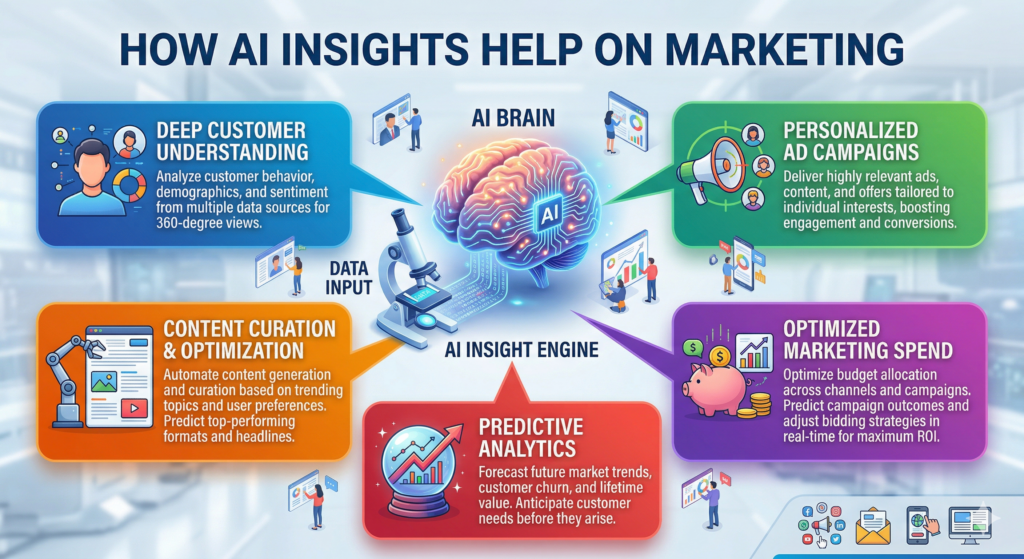
Enhancing Customer Understanding Through AI
AI reveals who customers are, what they want, and how they behave. More importantly, it turns raw data into clear groups, tailored messages, and likely future actions that support smarter marketing decisions.
AI-Driven Audience Segmentation
AI groups customers based on patterns that marketers might otherwise miss. For example, teams use clustering and classification to segment customers by behaviours (purchase frequency, average order value), demographics (age, location), and engagement (email opens, time on site).
As a result, marketers can target high-value customers, re-engage lapsed buyers, and create lookalike audiences for acquisition.
Practical steps:
• Feed transaction, web, and CRM data into the model.
• Validate segments with A/B tests or lift analysis.
• Update segments regularly as behaviour shifts.
Overall, these actions lead to higher conversion rates for targeted campaigns and lower acquisition costs. However, teams should maintain human oversight to check for biased splits or data gaps.
Personalisation and Targeting
AI enables teams to create personalised experiences at scale. Specifically, it selects the right product, message, and channel for each customer based on past purchases, browsing behaviour, and response history.
For example, systems can automatically personalise website banners, email subject lines, and ad creatives.
To implement this effectively, teams map trigger rules and machine learning recommendations into CMS and marketing automation systems. Meanwhile, business rules can override model outputs when necessary (for promotions or compliance).
To measure impact, marketers should track KPIs such as click-through rate, average order value, and retention. In addition, teams must ensure transparency in data usage and test model-driven content against rule-based alternatives.
Predictive Customer Behaviour Analysis
Predictive models forecast actions such as churn, next purchase timing, or likely product interest. Therefore, marketers can prioritise outreach for customers at high churn risk or those likely to purchase premium items soon.
Typically, teams train models on time-series data, recency-frequency-monetary features, and engagement signals. For example, they may use survival analysis for churn timing and gradient-boosted trees for purchase propensity.
Next, teams operationalise predictions by scoring customers daily and feeding those scores into campaign tools. They can also pair scores with decision rules—for instance, sending a retention offer when churn probability exceeds 30% and lifetime value exceeds a defined threshold.
To ensure reliability, teams should validate models with holdout sets and monitor calibration regularly to prevent drift.
Optimising Marketing Campaigns with AI Insights
AI provides clear signals about what works, who responds, and where teams should allocate time and budget. In turn, it transforms raw data into specific actions that teams can test and scale quickly.
Campaign Performance Measurement
AI tracks metrics beyond clicks and impressions to show which actions drive revenue and retention. For instance, predictive models estimate lifetime value (LTV) and conversion probability for each user, helping marketers prioritise high-return audiences.
Additionally, teams can set up automated dashboards that refresh hourly and flag anomalies, such as sudden drops in add-to-cart rates or spikes in cost per acquisition (CPA).
At the same time, machine learning–powered attribution models compare first-touch, last-touch, and multi-touch impacts, enabling more accurate credit allocation across channels.
Furthermore, A/B tests and multi-armed bandit approaches allow AI to shift traffic toward top-performing creatives or landing pages in real time. However, human oversight remains essential to ensure alignment with brand goals.
Content Optimisation
AI analyses which headlines, images, and calls to action generate the best engagement for each audience segment. Then, it uses performance data to recommend content tailored by age, location, and purchase intent.
Moreover, generative tools create multiple asset variants quickly, while AI scores them for predicted click-through rate (CTR) and conversion. Human review ensures tone, accuracy, and compliance.
In addition, natural language processing (NLP) identifies common customer questions and sentiment, helping teams refine copy, FAQs, and email subject lines. Teams should track impact using metrics such as time on page and conversion rate.
Channel and Budget Allocation
AI evaluates channel performance using real-time signals rather than fixed assumptions. Specifically, it combines conversion, CPA, and incremental lift into a unified model that guides budget allocation across search, social, email, and programmatic channels.
Teams can set rules that allow small daily adjustments and larger weekly shifts. Meanwhile, scenario simulations help teams test how budget changes affect outcomes under different conditions.
To maintain strategic alignment, teams can enforce constraints such as minimum brand presence and maximum CPA. Additionally, AI detects channel saturation and diminishing returns.
Driving Sales and ROI Using AI Analytics
AI analytics identifies where marketing spend works best, which prospects are most likely to convert, and which sales activities generate the highest revenue. Consequently, teams gain clearer funnel visibility and improve lead prioritisation.
Sales Funnel Improvements
AI maps funnel stages using signals such as page visits, content downloads, and demo requests. As a result, teams can clearly identify drop-off points and their causes.
Moreover, predictive models estimate conversion probabilities at each stage, enabling more accurate targets and better budget allocation. Automated alerts also notify teams of changes in segment performance.
Lead Scoring and Nurturing
AI scores leads based on likely revenue rather than activity alone. Specifically, models use CRM data, email engagement, firmographics, and purchase history to produce a single prioritisation score.
As a result, teams can personalise nurturing at scale by selecting the best channel, content, and timing for each prospect.
Additionally, workflow rules trigger human follow-up for high-value leads and automated sequences for lower-priority ones. Teams should monitor model drift regularly to maintain relevance.
Navigating Challenges and Ethical Considerations in AI Marketing
Organisations must apply practical controls to protect customer data, minimise bias, and ensure transparency in AI-driven decisions.
Data Privacy and Security
Teams should treat customer data as a high-risk asset. Therefore, they must limit data collection to what is necessary and clearly document its purpose.
In addition, teams should implement encryption, role-based access, and audit logs as essential safeguards. Regular vulnerability scans, third-party compliance agreements, and clear consent mechanisms further strengthen security.
Bias Minimisation
Teams must identify and mitigate bias across data sources, labelling, sampling, and modelling processes.
To achieve this, they should evaluate performance using segmented metrics across demographics and apply techniques such as reweighting and resampling to correct imbalances.
Transparency and Accountability
Organisations should ensure that AI-driven decisions remain explainable to customers and regulators. Therefore, teams must clearly communicate when AI influences pricing, targeting, or recommendations.
Additionally, internal documentation of models, inputs, and performance metrics supports compliance. Teams should assign ownership for each model and conduct regular reviews and impact assessments.
Unlock Marketing Success with AI Insights
AI insights help marketers make smarter decisions that align with business goals. To begin effectively, teams should start small with clear questions and reliable data.
AI supports better targeting, personalisation, and prediction. As a result, it reduces wasted spend and improves customer experience.
However, teams must continuously test and monitor performance as models and markets evolve. Ultimately, balancing automation with human judgement ensures the best outcomes.
Quick checklist:
• Define one clear metric to improve.
• Choose trustworthy data sources.
• Run a small pilot and measure lift.
• Scale with guardrails for privacy and bias.
AI enhances speed and pattern recognition, but it does not replace creativity or strategic thinking. Instead, marketers should use it as a tool to support decisions—not replace them.
FAQ
What can AI insights do for marketing?
AI finds patterns in data quickly. Marketers can use these patterns to target customers, predict trends, and improve campaign timing.
Are AI insights accurate?
Accuracy depends on data quality. Therefore, teams should always validate outputs with human judgement.
Will AI replace marketers?
AI automates tasks and suggests actions. However, humans still lead strategy, creativity, and ethical decisions.
How to get started with AI insights?
Start with a clear question and quality data. Then, use simple tools such as segmentation or A/B testing before scaling.
What about privacy and ethics?
Teams must ensure compliance with data laws, maintain transparency, and use data responsibly.
Which tools should be considered?
Marketers should prioritise tools that offer real-time analytics, customer profiling, and campaign optimisation.
How to measure ROI from AI-driven marketing?
Track metrics such as conversion rate, customer lifetime value, and cost per acquisition, and compare them against previous performance.
What are common pitfalls?
Common issues include poor data quality, unaddressed bias, and overreliance on AI outputs without human validation.