





Asli Theme Kit - React Digi
100

AI Search Optimization: Beyond SEO in the Modern Era

aiseo2

SEO (Search Engine Optimization) is the practice of improving a website’s visibility in organic search results by aligning with search engine algorithms. Its core strategies include:

  • On-page elements: Optimizing content for relevance and readability, including keyword placement in titles, headers, and meta descriptions. High-quality content that matches search intent is prioritized, along with internal linking to improve site structure.

  • Technical SEO: Ensuring a website is crawlable and indexable by search engines through fast load speeds, mobile responsiveness, structured data (Schema markup), and secure connections (HTTPS). Fixing errors like broken links and duplicate content also falls under this category.

  • Backlinks: Earning links from authoritative external sites to boost domain authority. Search engines view backlinks as endorsements, so a strong backlink profile improves rankings — though manipulative tactics (like spammy link-building) can lead to penalties.

For years, SEO success depended on mastering these elements while adapting to algorithmic updates like Google’s Panda and Penguin. However, the rise of AI-powered search engines—such as Google’s SGE (Search Generative Experience) and conversational AI like ChatGPT—is reshaping search behavior. Users now expect direct, context-aware answers, shifting the focus from traditional rankings to AI Search Optimization. This new approach emphasizes structured data, natural language content, and authority signals that help AI models retrieve and cite your information, making it essential for future-proofing search visibility.


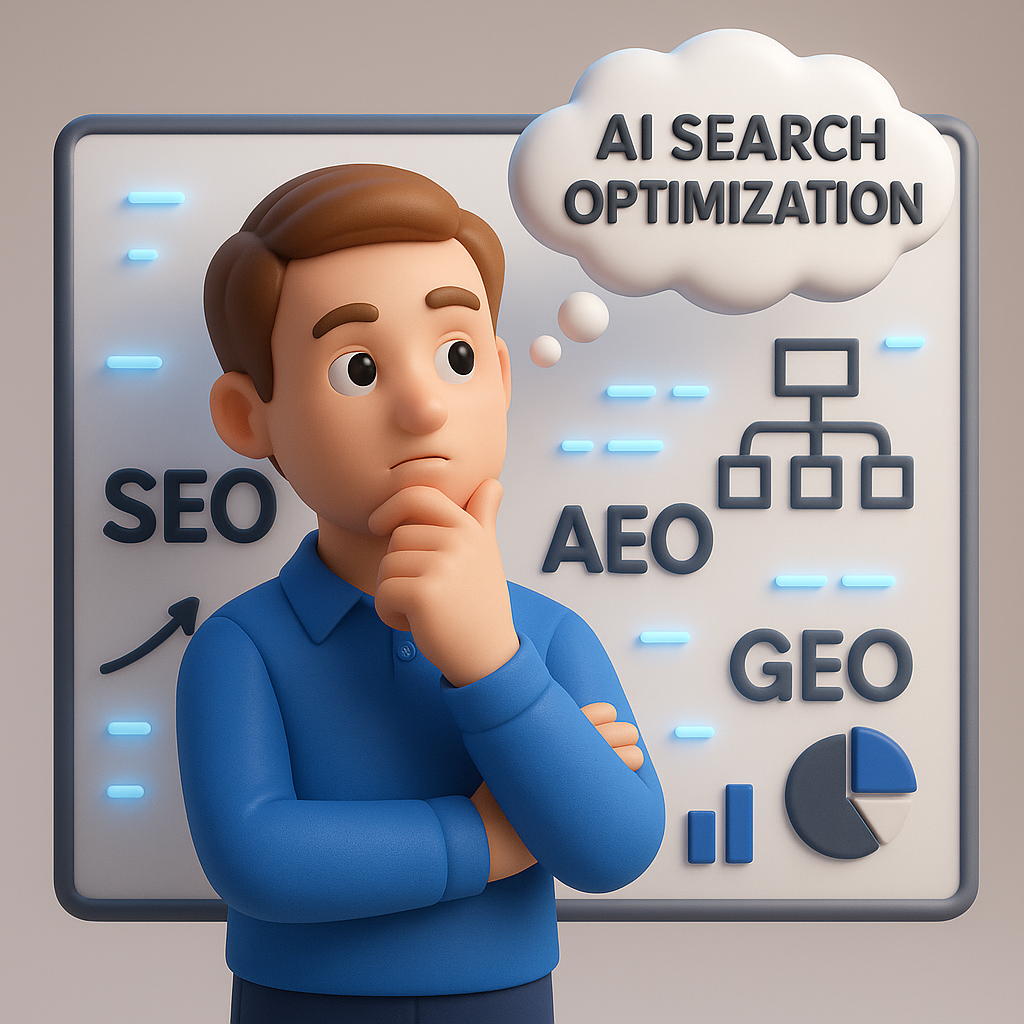
AI Search Optimization

AI Search Optimization is the practice of tailoring content, technical infrastructure, and metadata to improve visibility in AI-driven search engines like Google’s AI Overviews, Perplexity, and ChatGPT. Unlike traditional SEO, which focuses on keyword rankings and backlinks, AI Search Optimization prioritizes contextual relevance, structured data, and conversational alignment to ensure content is selected, summarized, and cited by AI models.

Key Aliases / Modules of AI Search Optimization:

  1. Answer Engine Optimization (AEO) – Focuses on optimizing content for AI tools that provide direct answers (e.g., ChatGPT, Gemini). AEO emphasizes clarity, conciseness, and authority to increase the likelihood of being sourced in AI-generated responses .

  2. Generative Engine Optimization (GEO) – Tailors content for generative AI platforms (e.g., Google’s SGE, BingChat) by aligning with how LLMs retrieve and synthesize information. GEO strategies include semantic keyword integration and structured markup to enhance AI interpretability.

  3. LLM Optimization (Large Language Model Optimization) – Targets the technical and linguistic preferences of models like GPT-4 and Claude, ensuring content is easily parsed and trusted by AI systems.

These terms reflect the evolving search landscape, where AI agents—not just algorithms—curate and deliver information. For simplicity, we’ll group all these concepts under AI Search Optimization (ASO), the umbrella term for strategies ensuring visibility in AI-powered search experiences


Opportunities with AI Search Engines

OpportunityDescription
💡 Featured AI Overviews
Optimizing content for Google’s AI Overviews (AIO) requires concise, well-structured answers that directly address user queries. By using clear headers, bullet points, and authoritative sourcing, brands can increase their chances of being featured in AI-generated summaries. This visibility often leads to higher click-through rates, as AI Overviews prioritize accuracy and readability.
📈 AEO + GEO comboCombining Answer Engine Optimization (AEO) and Generative Engine Optimization (GEO) ensures content is both question-focused and deeply informative. Structuring articles in Q&A formats while covering long-tail subtopics helps AI models extract and cite responses more accurately. This dual approach improves rankings in traditional SERPs and AI-driven platforms like ChatGPT or Google’s SGE.
🔎 Rich‑snippet readinessAI search engines prioritize pages with schema markup (FAQ, How-To, and Article structured data), as it helps them parse and display key information. Clear headings, bulleted lists, and concise definitions further enhance machine readability, increasing the likelihood of appearing in featured snippets or AI-generated answers.
⌛ Faster updates
Unlike traditional search engines, AI models like Gemini and Perplexity refresh their knowledge bases frequently. Regularly updating content—especially statistics, trends, and FAQs—ensures alignment with the latest AI-indexed data. This agility helps maintain relevance in fast-moving industries.
🎯 Conversational content designRewriting technical or marketing-heavy language into natural, dialogue-friendly phrasing improves AI comprehension. Tools like Google’s Natural Language API can analyze readability, ensuring content mirrors how users ask questions—critical for voice search and AI chat responses.

It is also important to recognize that not all AI-powered search engines behave the same way. Each platform—from Google’s AI Overviews to ChatGPT, Perplexity, and Bing’s AI—has unique algorithms, content preferences, and ranking behaviors. What works for one may not guarantee success in another. In the next section, we’ll explore these key differences, breaking down how to tailor your strategy for maximum visibility across the evolving landscape of AI-driven search.


ReactDigi offers services such as Web Design, Web Development, SEO, AI Product Development, etc.

Exploring Different AI Search Engines

1. Google AI Overview

Google’s AI Overviews (formerly SGE) surface at the top of Search Engine Results Pages (SERPs), delivering AI-generated summaries and key link cards from multiple sources—perfect for users seeking a quick but authoritative answer (techtarget.com).
In AI Mode, available via Google Labs since July 1, 2025 (launched fully in the U.S. on June 27, 2025), the experience is enhanced using Gemini 2.5 (houstonchronicle.com). It features:

  • Query fan-out searches: conducts parallel sub‑queries and synthesizes them into coherent answers (houstonchronicle.com).

  • Multi-modal inputs: supports voice, images, follow-ups, and conversational threads. Users can start with a text question, then switch to voice or image-based queries mid-search (houstonchronicle.com).

  • Rich features: includes charts, dynamic sliders, audio summaries, and even live ticket‑buying capabilities in development (techtarget.com).

Opportunities for optimization:

  • 🔗 Structured source links — being linked in AI Overviews gets direct attention.

  • ✍️ Concise, authoritative answers — ensure your content aligns with the depth AI Mode seeks.

  • ⏱️ Frequent content refresh — Google cites 30% fewer clicks, so freshness matters to stay visible (reddit.com, directivegroup.com).


2. Bing Copilot

Bing Copilot, powered by Microsoft’s Prometheus model built on GPT‑4/GPT‑4 Turbo, merges Bing’s traditional index with generative AI—yielding answer summaries instead of just blue links. It lives across Edge, Windows taskbar, Xbox, Microsoft 365, and enterprise tools.

What sets it apart:

  • 🔄 Context-aware dialog: remembers query context and supports follow-ups—like ChatGPT within search.

  • 🧠 Semantic & entity focus: rewards well‑structured content with schema, FAQ, and HowTo markup.

  • 🏗️ Enterprise synergy: when tied to Microsoft 365 (SharePoint, Teams), Copilot may surface internal documentation directly .

  • Performance-driven indexing: faster-loading, mobile-ready pages are prioritized (lawrencehitches.com).

SEO strategies for Bing Copilot:

  • Utilize FAQ/How-To schema and clear, bite-sized answers.

  • Focus on E‑E‑A‑T: Experience, Expertise, Authority, Trust, cited by Copilot (lawrencehitches.com).

  • Optimize load-speed and clarity—Copilot prefers streamlined content (lawrencehitches.com).


3. ChatGPT’s Search Feature

ChatGPT Search (also SearchGPT) integrates live web retrieval into GPT‑4, launched mid‑2024. It crafts polished answers with hyperlinks to sources. While primarily conversational, it actively cites and contextualizes for credibility.

Unique advantages:

  • 🎯 Single-point answers: users get authoritative responses without browsing multiple links.

  • 📌 Citations matter: factual accuracy with sources—your content must be trustworthy.

How to align:

  • Structure content with clear headings and concise summaries first, expanded depth follows.

  • Include in-text citations and external reputable links to boost content citation.

  • Ensure content accuracy and clarity, since misleading info may be penalized.


4. Perplexity’s Search Feature

Perplexity.ai blends traditional search with generative AI, offering Quick (summary) and Pro (detailed review) modes. Known for source accuracy and ChatGPT-like citations.

Key strengths:

  • ☑️ Dual-format output: a short synopsis plus deeper analysis caters to all user types.

  • 🔍 High citation transparency: Perplexity meticulously links each fact to sources.

How to optimize content:

  • Layer content: intro summary + detailed body, to serve both Quick and Pro modes.

  • Use citations liberally, making it easy for AI to reference specific data points.

  • Employ structured lists and highlight key facts upfront—Perplexity favors extractable snippets.


Our Recommendations

1. Craft content around real questions

  • Start each article or section with clear, natural-language questions (e.g., “What is AI search optimization?”).

  • Follow up with direct, concise answers—this helps AI like Google Overviews or ChatGPT pick up your content easily grammarly.com+10en.wikipedia.org+10en.wikipedia.org+10.

2. Use readable structure and formatting

3. Layer content from summary to deep dive

  • Begin with a brief overview, then expand into in-depth sections.

  • This two-tiered design appeals to both Quick/Pro formats in Perplexity and enables better citation in GEO contexts .

4. Include rich internal linking and topic clusters

5. Encourage trust with citations and freshness

  • Reference credible sources and include pull quotes or featured statistics—AI tools value expertise and recency .

  • Regularly update information to stay current in both SEO and AEO result.

6. Add FAQs and use a conversational tone

  • Integrate an FAQ section using everyday language and schema markup.

  • AI engines often surface Q&A-style answers from such sections via AEO

At ReactDigi, we understand that traditional SEO remains crucial. However, when we work on SEO, we take one step further by weaving in AI Search Optimization patterns into every piece of content, ensuring our clients’ websites are not only well-ranked in classic search results but also prioritized in AI-powered platforms. By integrating robust SEO foundations—like site structure, speed, and keyword strategy—with targeted AEO, GEO, and AIO techniques, we help our clients excel in both realms, delivering superior visibility in search engines and AI-generated answer engines.

ReactDigi offers services such as Web Design, Web Development, SEO, AI Product Development, etc.